›
Tagore
Then you've already started. The walk is on decoloniality — what it has actually been, in practice, for a century longer than the word. We can begin in Bengal, in 1901, with a school under the trees.
Rabindranath Tagore was born in 1861 in Calcutta. Poet, painter, composer, novelist, educator. Nobel laureate in Literature in 1913 — the first non-European to receive it. The first sentence everyone learns about him is the second one he would have wanted them to learn.
The first move that mattered was pedagogical. In 1901 he founded a school at Santiniketan, in rural West Bengal, with five students. The classes were held outdoors under the mango trees. The British colonial curriculum was refused. The students learned Sanskrit, Bengali, English, Persian, and Chinese. They drew the trees they were sitting under. By 1921 the school had become Visva-Bharati University. Its motto was the line from the Mahā Upaniṣad: Yatra Visvam Bhavati Eka Nidam — where the world makes its home in a single nest.
Important: Tagore was not anti-Western. He was anti-empire. He corresponded with Einstein. He met Yeats. He travelled to Argentina in 1924, where his lectures shaped a generation of Latin American writers. He went to China and Japan and lectured against the imperial ambitions of Japan to its own intellectuals. His decoloniality was relational, not isolationist. The world made its home in a single nest, but the nest was not London or Paris.
In 1919, after the British army massacred unarmed Indians at Jallianwala Bagh, Tagore returned the knighthood the British Crown had given him. He wrote, in his letter to the Viceroy, that he wished to stand "shorn of all special distinctions" by the side of his countrymen.
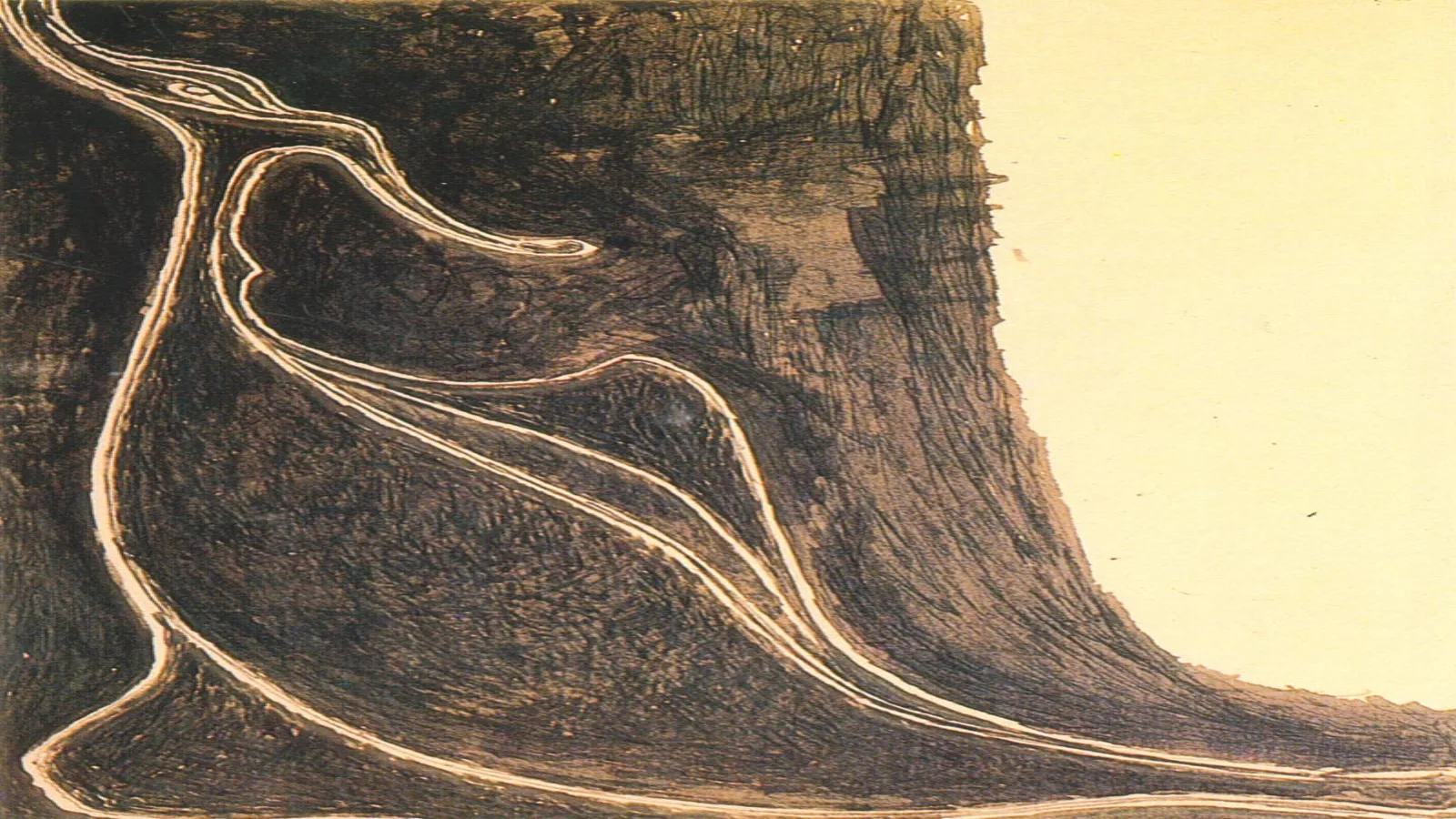
His paintings are among the strangest things he made. He started painting at sixty-five — figures, masks, animals, corrected manuscript pages turned into doodles turned into compositions. They do not look like Bengali miniatures. They do not look like European modernism. They are evidence of what happens when someone refuses both frames and improvises a third.
We can stay with Tagore — his correspondence with Einstein, his Argentine lectures, his arguments with Gandhi about the nation — or we can move forward to Santiniketan, the school he made, which is still operating.
Santiniketan
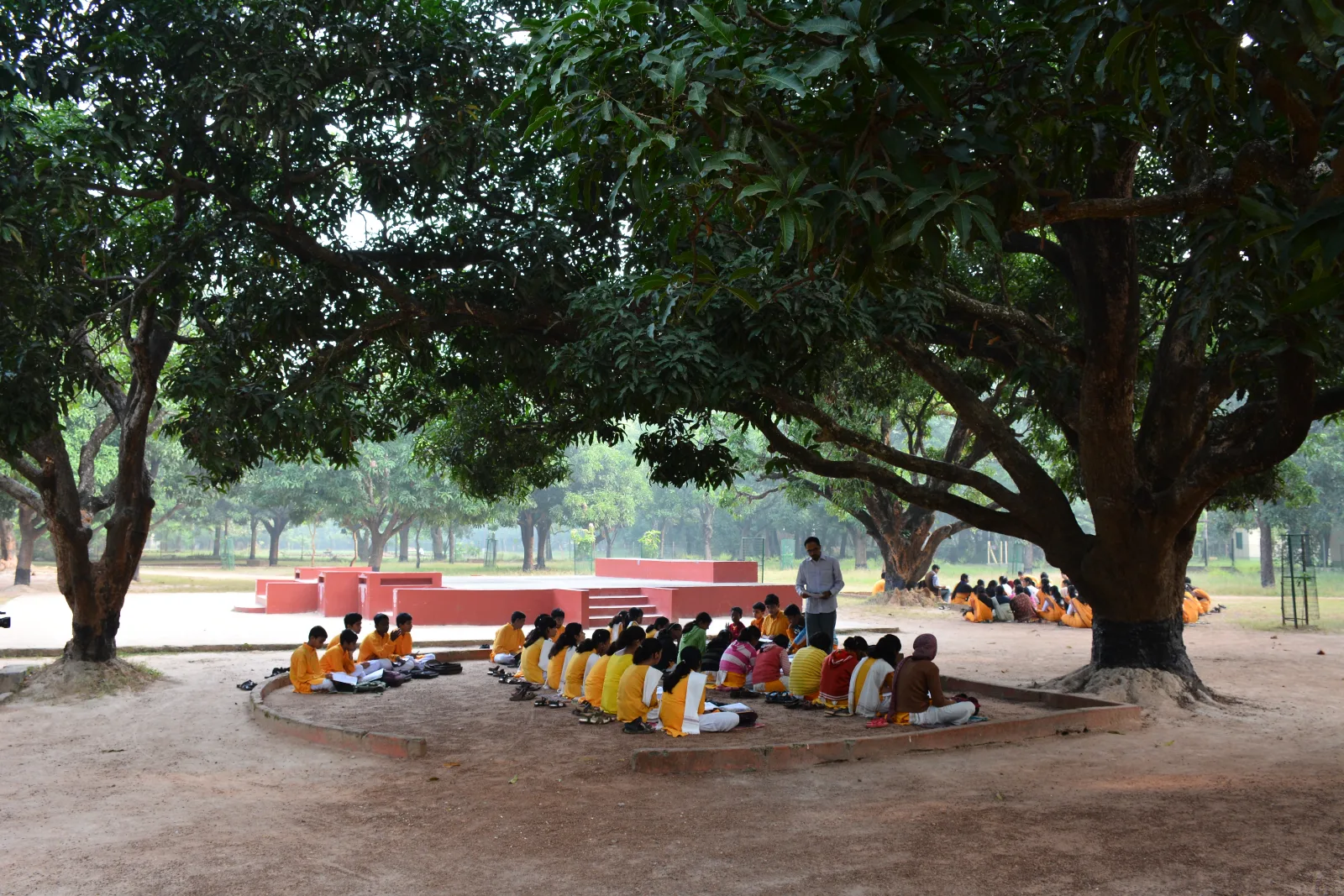
The school is still there. Visva-Bharati University, in Santiniketan, West Bengal. Founded 1921. Today it has seven thousand five hundred students.
The faculty in the early decades included some of India's most consequential modernist artists. Nandalal Bose, who designed the calligraphic illustrations for the Constitution of India. Benodebehari Mukherjee, who painted the Hindi Bhavan murals while losing his sight. Ramkinkar Baij, who made the first modern public sculptures in India out of cement and laterite.
What was at stake in the school was spatial. The classes were under the trees. There were no desks. Students drew what they were sitting in. The British curriculum, which would have imposed English aesthetics from a four-walled classroom, could not survive the trees.
R. Siva Kumar, the scholar who has written most extensively about the Santiniketan painters, has called the school "the first sustained attempt to imagine art outside the colonial frame, before the word decolonial existed." The point is the dating. Decolonial theory as a named field arrives in the 1990s. Santiniketan had been doing the work since 1901.
Read this against what Bauhaus would do twenty years later in Weimar. The Bauhaus is the canonical art-school-as-experiment. Santiniketan predates it. Santiniketan also outlasted it — the Bauhaus was closed by the Nazis in 1933, after fourteen years. Santiniketan has been teaching for one hundred and twenty-four.
From here we can stay with the Bengal School — Bose, Mukherjee, Baij, the painters and sculptors who came out of Santiniketan and shaped Indian modernism — or we can move sideways across the Pacific, to Mexico, where a painter who renamed himself in Nahuatl was redrawing the colonial map.
Atl
Gerardo Murillo was born in Guadalajara in 1875. He studied painting in Mexico City, then in Rome and Paris, then returned. In 1902, in his late twenties, he renamed himself Atl — Nahuatl for water — to mark his break from the Spanish-colonial naming. He kept the name for the next sixty years.
Atl was a painter, a volcanologist, and a publisher. He climbed Popocatépetl over two hundred times and produced an oeuvre of paintings of Mexican volcanoes that rendered them as living political bodies, which they are. He invented a wax-and-resin pigment he called Atlcolor that allowed him to paint in extreme atmospheric conditions, including on the slopes of erupting volcanoes.
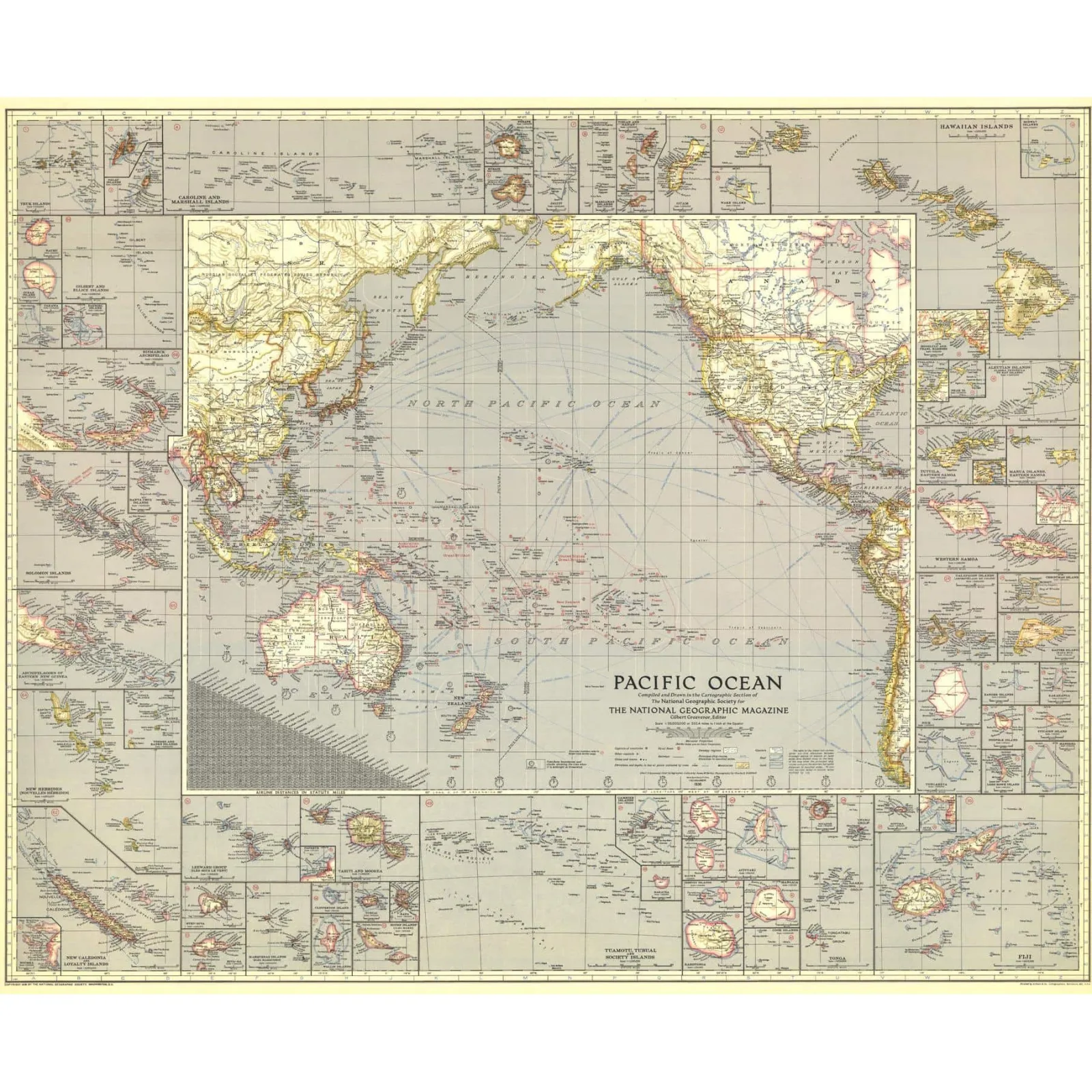
The decolonial move that matters here is cartographic. Beginning in the 1910s, Atl produced and published a series of maps that placed the Pacific Rim at the centre of the world. Mexico, in his maps, is at the geographic centre — because it sits on the Pacific. The Mediterranean is a small inland sea on the eastern edge. North America is positioned in ways that the Mercator projection had taught Europeans to find disorienting.
The point of the maps was not aesthetic. It was an argument: the colonial map is a colonial document. The Mercator projection, which Gerardus Mercator drew in 1569, was designed to support European maritime navigation and Eurocentric world-imagining. Atl's maps refuse the projection. They place the geography that the colonial map had pushed to the periphery at the centre, and let the centre go to the edge.
Atl was also the figure who organized the artistic programme of the post-revolutionary Mexican government in 1921. The murals that followed — Diego Rivera at the National Palace, José Clemente Orozco at the Hospicio Cabañas in Guadalajara, David Alfaro Siqueiros at the Polytechnic — were a public-art project on a scale that no European country was attempting. The murals were a decolonial movement that looked, at first glance, like a national-art movement. Looked at again, they were the country narrating itself in a register the colonial museum had no shelf for.
We can stay with Mexican muralism — Rivera, Orozco, Siqueiros, the Polytechnic murals, the cycle at the Detroit Institute of Arts — or we can move sideways across the Caribbean, to a body of work that responded to a different colonial history with a different aesthetic register.
Noël
Samantha Noël is an art historian at Wayne State University. Her book Tropical Aesthetics of Black Modernism, published by Duke in 2022, is the most careful argument that has been made for what the artists of the African diaspora were actually doing in the early twentieth century.
The argument: Caribbean and African-American artists between roughly 1925 and 1945 were not influenced by Western modernism. They were rebuilding it. The European modernists — Picasso most famously — had borrowed from African sculpture without naming it as borrowing. The Demoiselles d'Avignon (1907) is the canonical case. The masks on the right side of that painting are not invented by Picasso. They are extracted from West African ritual objects he had seen at the Musée d'Ethnographie du Trocadéro.
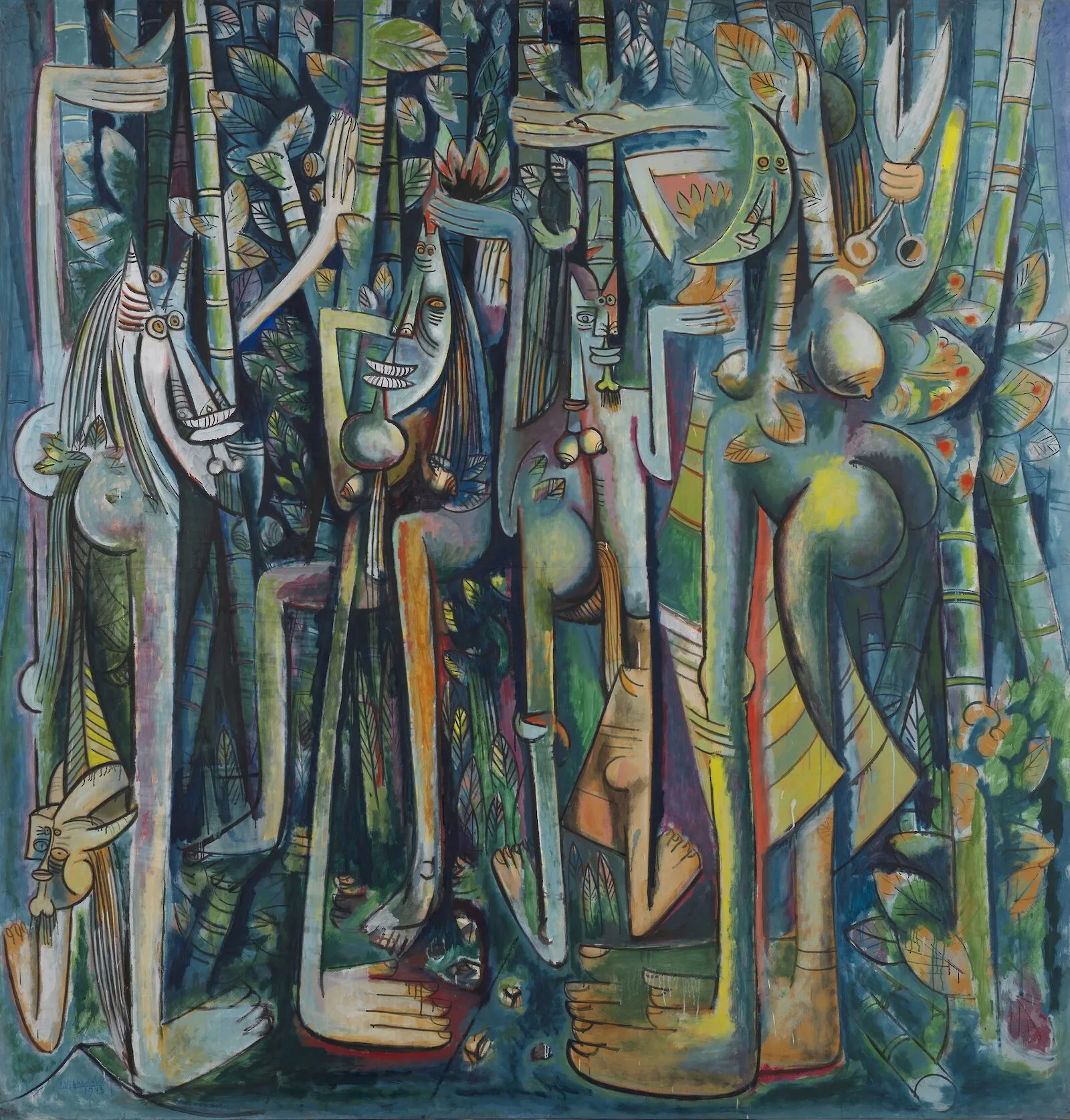
What Noël tracks is the response. Wifredo Lam — Cuban, of Chinese, African, and Spanish descent — went to Paris in 1923, knew Picasso personally, returned to Cuba during the Second World War, and painted The Jungle in 1943. The painting takes the visual codes Picasso had borrowed from African art and returns them to the African diaspora through Cuban context. It is a painting against the Demoiselles. Lam exhibited it the same year Picasso was at the height of his international fame.
Aaron Douglas painted murals at Fisk University and the New York Public Library in the 1930s using silhouette in a register that read as Modernist. Noël reads the silhouette differently: as a deliberate restoration of the African body, the body Picasso's modernism had used as a mask without ever painting as a body.
Lois Mailou Jones's Les Fétiches (1938) put the Western modernist trope of the African mask on its head. Where Picasso had used the mask as a face on a European female body, Jones painted the masks themselves, foregrounded, as agents — as fétiches with their own gravity, not as decorative borrow.
Noël's term for this is tropical aesthetics. The "tropical" is not the colonial-exoticist tropical the European gaze had produced. It is a counter-aesthetic that reclaims the African and Caribbean source material from which European modernism had extracted, and rebuilds it as a coherent register of its own.
This is decoloniality through reclamation. Not a refusal of modernism but a refusal of the way European modernism had narrated itself.
We can stay with the Harlem Renaissance and its hemispheric reach — Aaron Douglas, Lois Mailou Jones, Hale Woodruff at the Talladega College murals — or we can move forward to Walter Mignolo, the theorist who would name, half a century later, what Lam and Douglas and Jones were already practising.
Mignolo
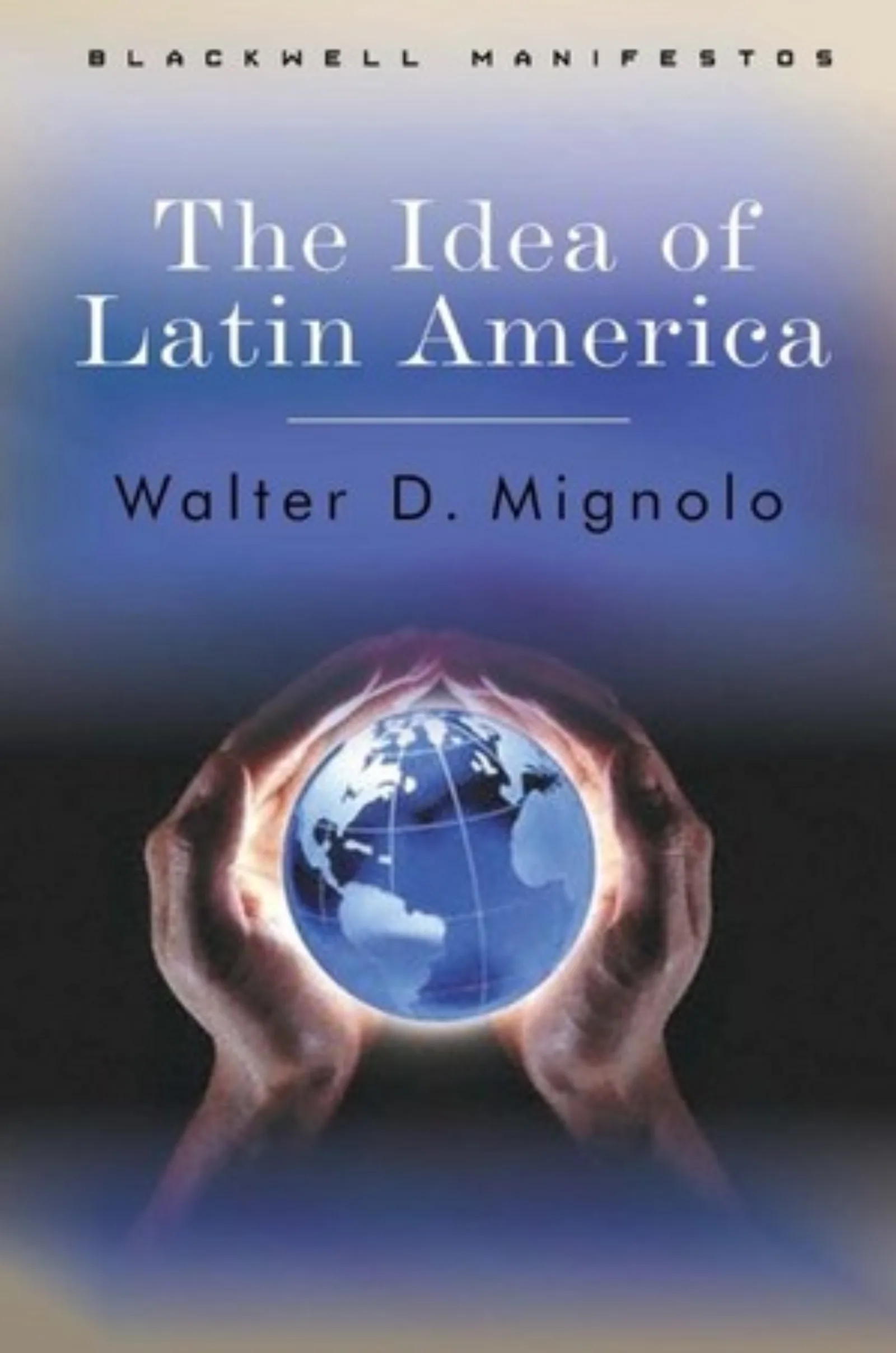
Walter Mignolo was born in Argentina in 1941 and has taught at Duke since the early 1990s. His central argument, made across roughly fifteen books, is that the conceptual frames the modern world treats as universal — including the frame of "Latin America" and the frame of "art" — are colonial inventions.
The Idea of Latin America (2005) makes the case for the first frame. The name "Latin America" was coined in France in the 1860s, by intellectuals around Napoleon III, to justify a French sphere of influence in the Americas distinct from the Anglo-Saxon north. Before the name, the region's inhabitants did not call themselves Latin Americans. They were Mexican, or Cuban, or Quechua-speaking, or Yoruba-descended, or Mapuche. The name "Latin America" did political work for Paris, not for the Andes.
The same move applies to art. The category we call "art" — the museum, the gallery, the auction house, the curator, the artist as singular author — is a European institutional invention from roughly the seventeenth through the nineteenth centuries. To call a Yoruba mask, a Mixtec codex, or a Tagore manuscript "art" is to subsume it under that European institutional frame. Mignolo's term colonial difference names what's happening: the colonial powers categorized the world's productions through their own frame, then trained the colonized to accept the frame as universal.
The walk has been showing the practice. Mignolo names the principle. Tagore in Bengal in 1901 was already practising what Mignolo would name in 2005. Atl was already practising it in Mexico in the 1910s. The Caribbean modernists Noël tracks were practising it in the 1930s. None of them were waiting for the theory.
Important: Mignolo does not reject art. He refuses to let "art" be the universal term. Other names exist. Sumak Kawsay, in Quechua, names a different relation to making — closer to "good living" than to "art object." Yatra Visvam Bhavati Eka Nidam, Tagore's school motto, names another. Mignolo's project is not to replace one universal with another. It is to leave room for the world's plural ways of making to keep being themselves.
The institution that built this walk uses the word "art" advisedly. It is the frame this walk inherits and, at the same time, the frame the walk is asking us to refuse. The walk does not resolve that tension. It holds it.
Leave a mark
That was the Decoloniality walk. Or one version of it. Other walkers have taken it through Frantz Fanon, through Aimé Césaire, through Audre Lorde, through Fred Moten and Stefano Harney, through the Otolith Group, through Theaster Gates's reclamation projects in Chicago. The path forks at every node.
Right now, two other people are still walking. One is at Tagore. One has just left a mark at Atl.
Before you go, you can leave a mark. A sentence. A link. An image of the work you carry with you that this walk made you reconsider.