›
Goya
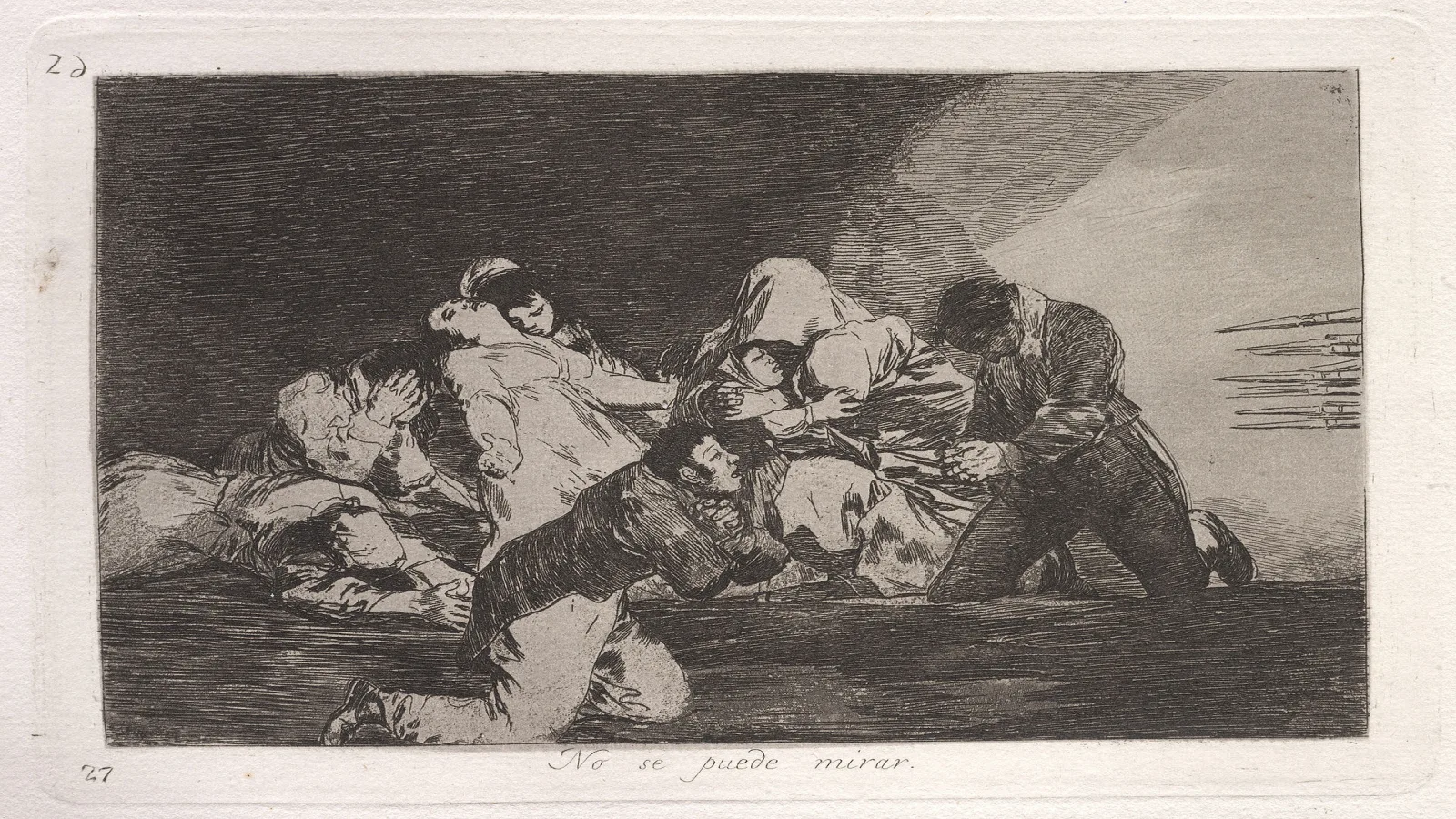
Then you've already started. The walk is on the image as an instrument of power, and as the only way to make power's violence visible. We can begin in Madrid, two hundred years ago, with a court painter who kept two careers running at the same time.
Francisco Goya was born in 1746 in Aragón. He was court painter to King Charles IV of Spain by 1789. He stayed in the role through Napoleon's invasion in 1808, through the rule of Joseph Bonaparte (Napoleon's brother, installed as king), and through the restoration of King Ferdinand VII in 1813. Three regimes. One court painter. The portraits of all three kings hung in his studio.
During those same years he made eighty-two etchings called Los Desastres de la Guerra — the Disasters of War. The series documents what the French army did to Spanish civilians, what Spanish guerrillas did to French soldiers, and what famine did to Madrid in 1811-12. The titles are caption-length: I saw it. And this too. Truth has died. One cannot look.
The etchings were not published in his lifetime. He kept them private. Publication would have ended his court position. They were first published in 1863, thirty-five years after his death.
This is the first move of the walk. The court painter and the witness were the same body. The image of state power and the image of state violence came out of the same hand, in the same workshop, in the same decade. Goya did not resolve the contradiction. He held it.
We can stay with Goya — the Black Paintings he made in his last years on the walls of his house, the witches, the Saturn devouring his son — or we can move forward in the same shape, a century later, to a Soviet filmmaker who survived Stalin by inventing the cinematic vocabulary that propaganda would use for the next century.
Eisenstein
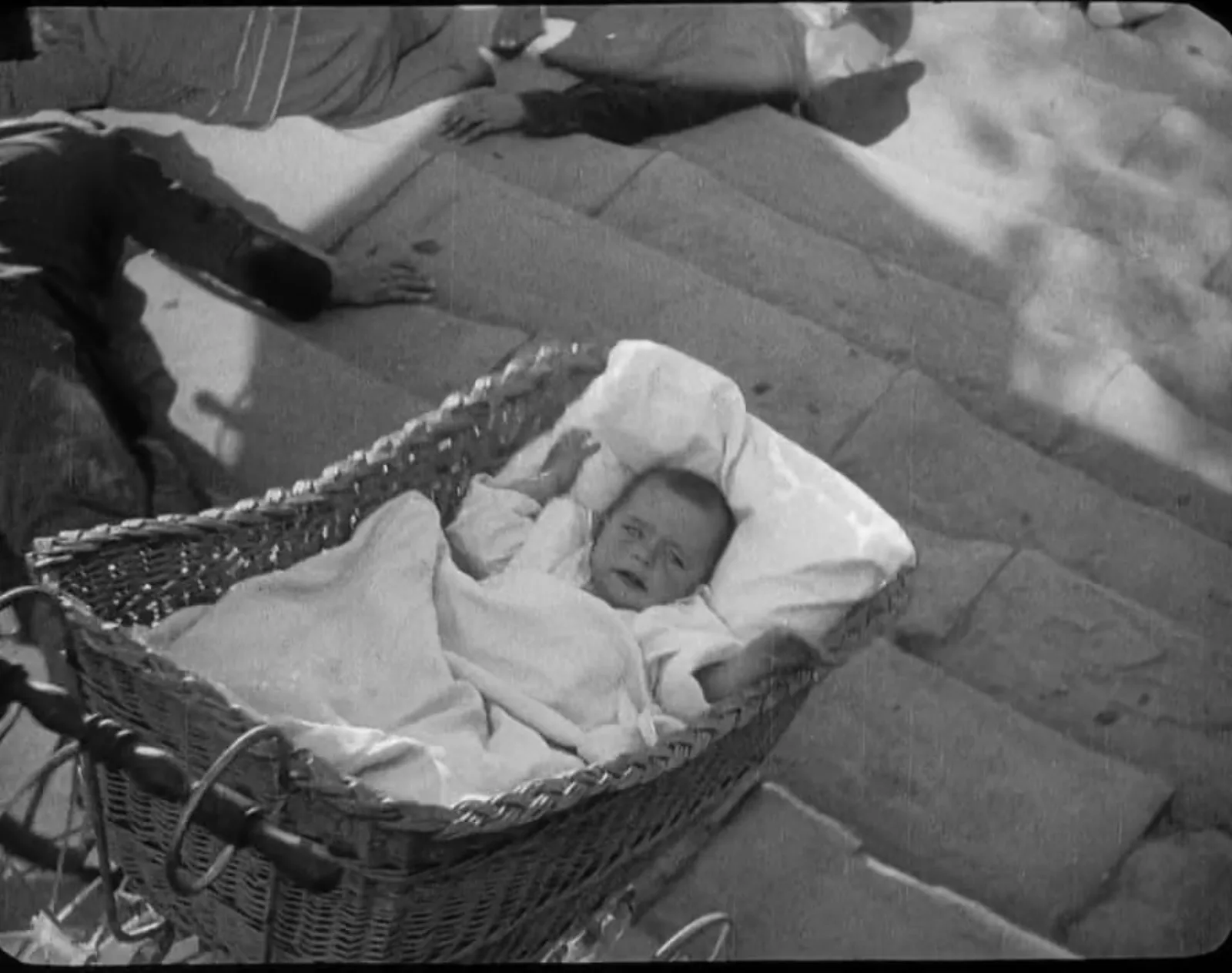
Sergei Eisenstein was born in Riga in 1898. He came to filmmaking through theatre and engineering. By twenty-seven he had made Strike (1925), which restaged the strike-massacre of 1903 as a parable about all state violence. By the end of the same year he had made Battleship Potemkin, which restaged the 1905 mutiny in Odessa as a parable about revolution. By thirty he had made October, which restaged the 1917 revolution as a parable about itself.
What he developed across those three films is now called montage. The cut between two unrelated images creates a third meaning that exists in neither image alone. The Odessa Steps sequence — the pram, the woman with the broken pince-nez, the Cossacks descending in lock-step — has been taught in every film school for ninety years. It is the canonical example of how propaganda works at the level of editing.
Eisenstein was Stalin's favorite filmmaker. Stalin personally screened his films at the Kremlin. He survived the purges of the 1930s when many of his colleagues did not. His later films — Alexander Nevsky (1938), Ivan the Terrible (1944-46) — were made under direct Stalin oversight. Ivan was understood by audiences and by Stalin alike as a study of a benevolent autocrat.
He died of a heart attack in 1948. He was fifty.
The shape is Goya's shape. The instrument that documents state violence (Strike) and the instrument that produces state propaganda (Alexander Nevsky) were the same instrument, in the same hand, in the same decade. The cinematic vocabulary of mass political feeling — the surge, the wave, the crowd that becomes one body — was invented for the Soviet state. It is now used by every state and every advertiser. Goya's contradiction had moved from etching to film.
We can stay with Eisenstein — Ivan the Terrible Part 2 was banned by Stalin and not seen until after Stalin's death; the story of the censorship is its own argument — or we can move forward fifty years to a New York artist who made the Eisenstein move in reverse: appropriating the propaganda image and returning it to the gallery wall as evidence.
Longo
Robert Longo was born in 1953 in Brooklyn. He came to attention in the late 1970s as part of what the critic Douglas Crimp would call the Pictures Generation — Cindy Sherman, Sherrie Levine, Richard Prince, David Salle, Longo. The argument the Pictures Generation made: the image had become the medium. There was no longer a stable difference between a photograph and a painting; what mattered was where the image came from, who was using it, and what it was being used to do.
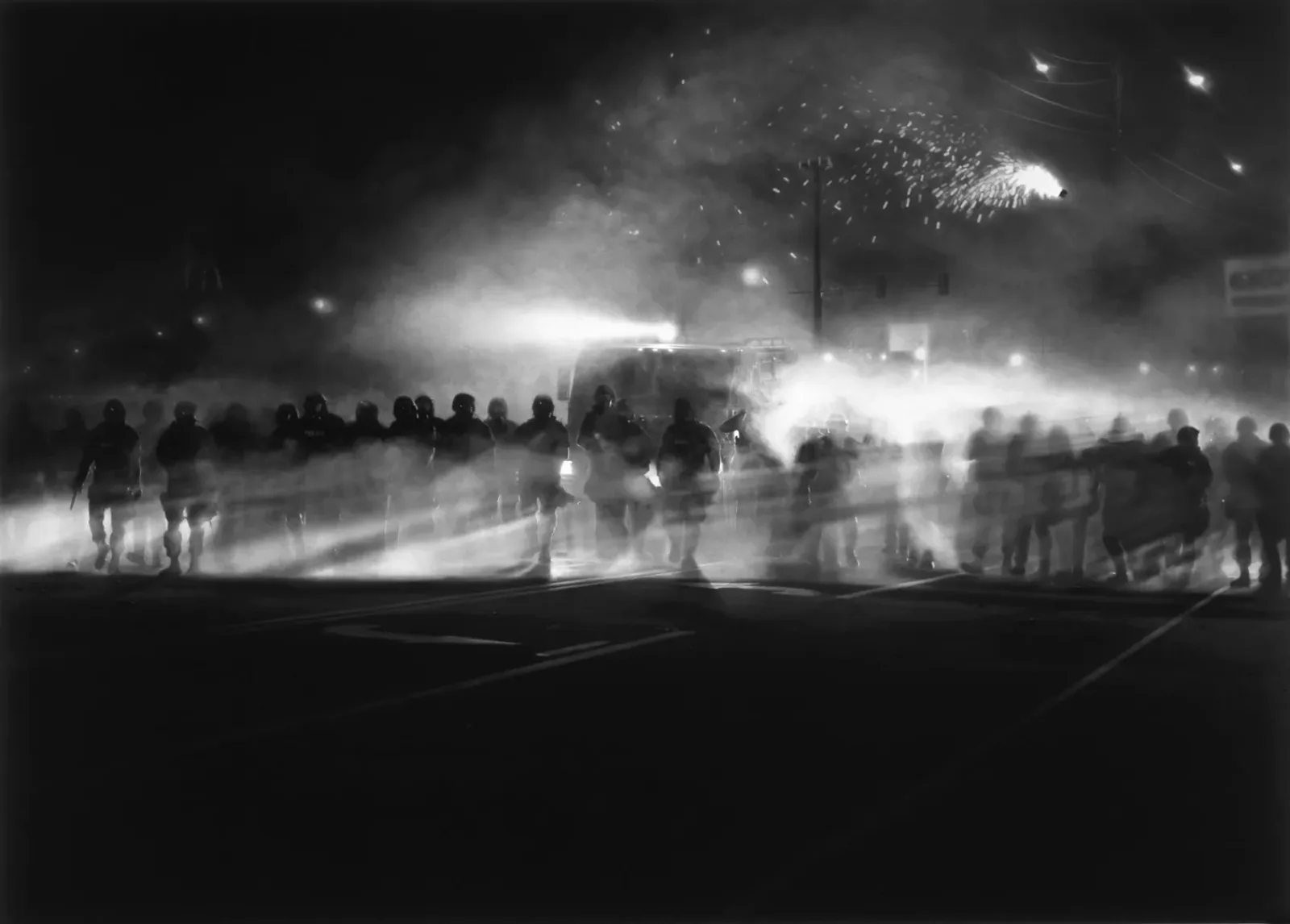
Longo's signature is the giant charcoal drawing. His Men in the Cities series (1979-83) showed contorted figures in business attire, derived from photographs of his friends mid-action. The drawings are six feet tall. At a distance they read as photographs. Up close they are charcoal — every mark visible, every shadow drawn by hand.
His later work moved toward direct political content. Untitled (Ferguson Police, August 13, 2014) is a ten-foot-wide charcoal drawing made from a wire-service photograph of Ferguson, Missouri, after the police killing of Michael Brown. The image is rendered in the same charcoal language as Men in the Cities. The figures are anonymous, militarized, in formation. The framing — the journalist's framing — is part of the work.
The same series includes massive renderings of pilgrims at the Hajj (a faceless crowd from a distance), refugees on a raft at sea, the inside of a mosque, the aftermath of Charlie Hebdo, Einstein's chalkboard.
The Brooklyn Museum showed the work in 2018, alongside Goya and Eisenstein, in an exhibition called Proof. The exhibition was a collaboration with the Garage Museum in Moscow — Roman Abramovich's foundation, Abramovich being one of Putin's chief financial backers. The exhibition history is part of the work, in the way Goya's court position was part of his.
Longo said in an interview in 1984: "I always imagine that I want to make art that is going to kill you." Forty years later the line reads as the artist's awareness that the image he was producing already had that capacity built in.
We can stay with the Pictures Generation — Cindy Sherman in her Untitled Film Stills (1977-1980), Sherrie Levine re-photographing Walker Evans, Richard Prince re-photographing the Marlboro Man — or we can move forward to the essayist who, while Longo was still in art school, had already named the contradiction the walk has been turning around.
Sontag
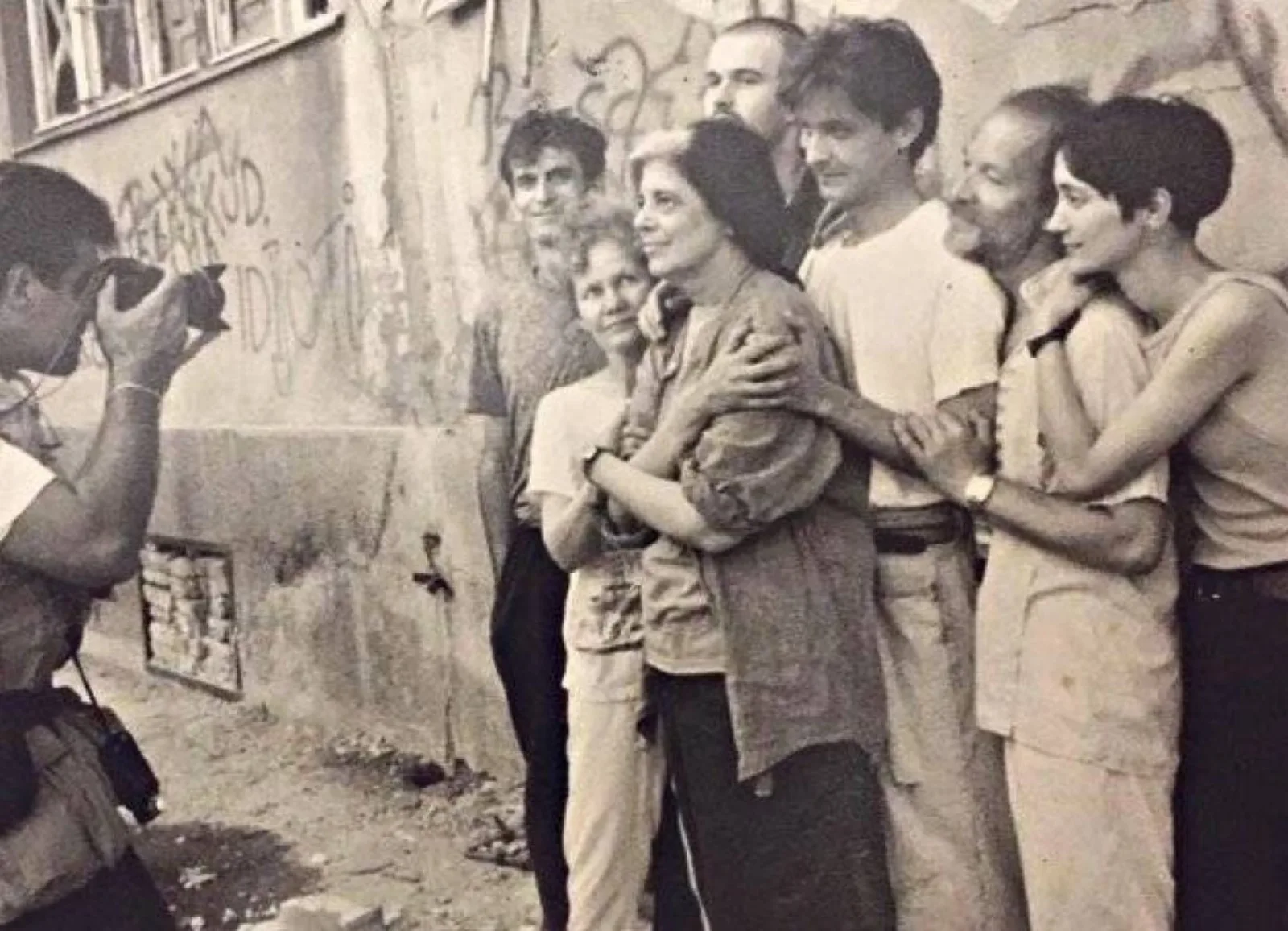
Susan Sontag was born in 1933 in Manhattan. By her early thirties she was the essayist of her generation. Against Interpretation appeared in 1966. Notes on Camp in 1964. On Photography in 1977. Illness as Metaphor in 1978. Regarding the Pain of Others in 2003. She died in 2004.
The line that this walk has been circling around, since Goya's etchings, is in the first chapter of On Photography:
Her argument: the camera is not a neutral instrument. The act of photographing — choosing the framing, the subject, the moment — is itself a form of selection that produces meaning the subject did not consent to. The camera trained on suffering is also a form of consumption of suffering. The photograph of war is itself a form of war. The viewer who looks at the photograph of a refugee is in a relationship with the refugee that the photograph helped create. There is no innocent looking.
Twenty-six years later, in Regarding the Pain of Others, she partly retracted. Or rather: she refined.
The photograph of suffering does consume, she wrote. But it also documents. It does extract — but it also bears witness. The photograph of the lynching is a participation in the lynching, and it is the only reason the lynching is now in the historical record. The photograph of the refugee is consumption, and it is the only reason the refugee's existence is registered by the institutions that decide her fate. The honest position is to hold both. To use the camera with full awareness that the camera is using you back.
Sontag's two positions, twenty-six years apart, match the walk's argument. The image-making technology is both complicit with power and the only way to make power visible. There is no neutral image. There is no innocent photograph. The witness is always a participant.
She went to Sarajevo eleven times during the siege. She directed Waiting for Godot in a candlelit theatre while shells fell. The play was about waiting for help that does not come. The audience waited with her in the candlelight. She did not write that the directing of the play would end the siege. She wrote that the directing of the play was the only thing she could do that was not consumption.
We can stay with Sontag — the Sarajevo essays, her last book on illness and photography of illness — or we can move forward to a contemporary filmmaker who has been working on the version of Sontag's question that her generation could not have foreseen.
Steyerl
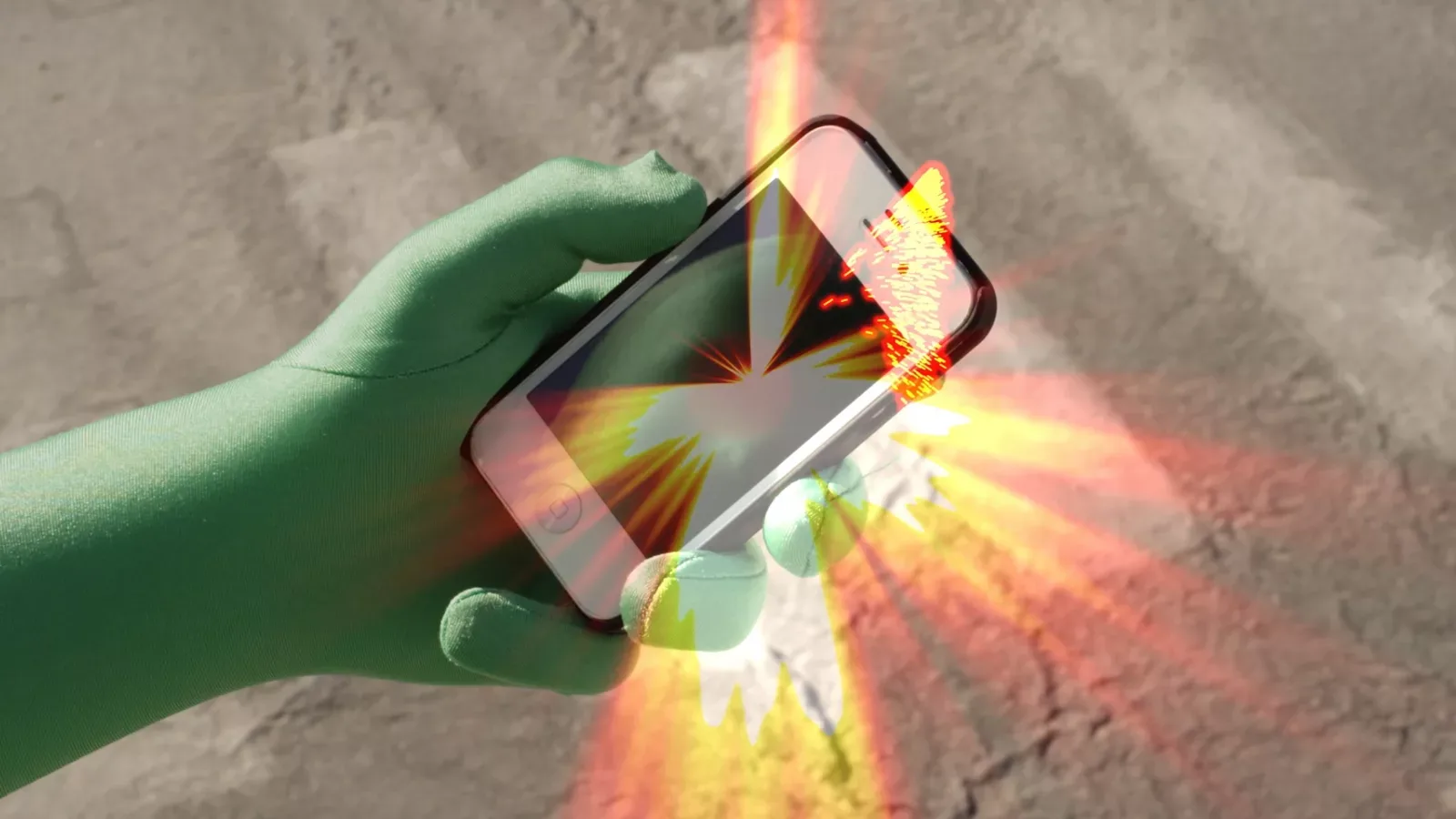
Hito Steyerl was born in Munich in 1966. She is a filmmaker, essayist, and professor at the Universität der Künste in Berlin. Her work is the contemporary version of Sontag's argument, made for the era in which the image is no longer a document of an event but the infrastructure that decides which events get to happen.
How Not to Be Seen: A Fucking Didactic Educational .MOV File (2013) is a fifteen-minute video shot at a former US Air Force calibration site in California's Mojave Desert. The site is a giant ground-painted target, used during the Cold War to calibrate aerial reconnaissance cameras. The video walks through the site's history while a deadpan narrator gives instructions for how to disappear from the surveillance image. The instructions are absurd and earnest at the same time. Lesson one: how to hide in plain sight. Lesson two: how to be female and over fifty. Lesson three: how to be a Wi-Fi signal.
Steyerl's later work has tracked how the image has moved from being a representation of a thing to being a unit of data. Contemporary AI training sets are built from billions of photographs scraped from the open internet. Facial recognition algorithms are trained on databases of mugshots from US police departments. The image is no longer the document of a moment. The image is the infrastructure that decides who gets seen, who gets surveilled, who gets prosecuted, who gets to disappear.
Her essay "In Defense of the Poor Image" (2009) made the same argument from the other direction. The compressed, low-resolution, much-shared, much-degraded JPEG that circulates on the open internet is the proletarian image. It is the image that has been used. It carries the marks of its circulation. The high-resolution image, archived in a museum's vault, is the bourgeois image — clean, original, owned.
Read this back through the walk. Goya kept his etchings private because publication would have ended him. Eisenstein survived Stalin by making the films Stalin wanted. Longo shows at museums funded by oligarchs. Sontag held that the camera was both aggression and witness. Steyerl's contribution is to name the infrastructure. The contradiction the walk has been turning around has not gone away. It has scaled, and it has industrialized.
The walk has been an argument that this is the structure of all image-making, across four centuries and three media. The structure is not a problem to be solved. It is the condition under which any image gets made. What the artists in this walk have shared is the willingness to use the instrument anyway, with their eyes open about what the instrument is doing to them and to what it pictures. None of them is innocent. None of them claims to be.
Leave a mark
That was the Power and Ideology walk. Or one version of it. Other walkers have taken it through Cindy Sherman's Untitled Film Stills, through Trevor Paglen's photographs of secret state imagery, through Forensic Architecture's investigations, through Allan Sekula's critique of documentary, through Walker Evans and the FSA, through Sharon Hayes. The path forks at every node.
Right now, one other person is still walking. She is at Eisenstein.
Before you go, you can leave a mark. A sentence. A link. A photograph that the walk made you reconsider.